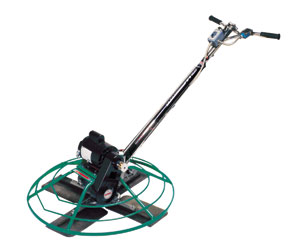
A power trowel is the standard tool for finishing concrete slabs after a pour. Once the surface has set enough to support the machine, the rotating blades work the concrete into a smooth, dense finish that hand troweling simply can’t match for speed or consistency.
This walk-behind unit covers a 36-inch path per pass, making it well-suited for garage floors, shop slabs, driveways, patios, and commercial flatwork. If you’re pouring more than a few square feet and want a professional finish, this is the machine for the job.
When to Use a Power Trowel
Timing is critical with concrete finishing. The trowel goes to work after the bleed water has evaporated and the surface can support the machine without leaving deep marks. Start with float blades to flatten and densify the surface, then switch to finish blades as the concrete hardens for the final smooth pass. Call us if you have questions about timing or blade selection for your specific mix and conditions.
Common Uses
- Garage and shop floors
- Concrete slabs and flatwork
- Driveways and patios
- Warehouse and commercial floors
- Any large pour requiring a smooth, professional finish
Specifications
| Trowel Diameter | 36 inches |
| Power Source | Gas powered |
| Blade Type | Combination / finish blades |
| Number of Blades | 4 |
| Application | Concrete slab finishing |
| Best For | Medium to large slabs and flatwork |
Complete Your Concrete Setup
A power trowel is the last step in the finishing process. Make sure you have everything else lined up before your pour — a mixer to batch the concrete, a buggy or vibrator to place and consolidate it, and a bull float to flatten the surface before the trowel goes to work.
Concrete Buggy
Bull Float
Concrete Vibrator
Towable Concrete Mixer
Call us to confirm availability and to get help choosing the right finishing setup for your job.